


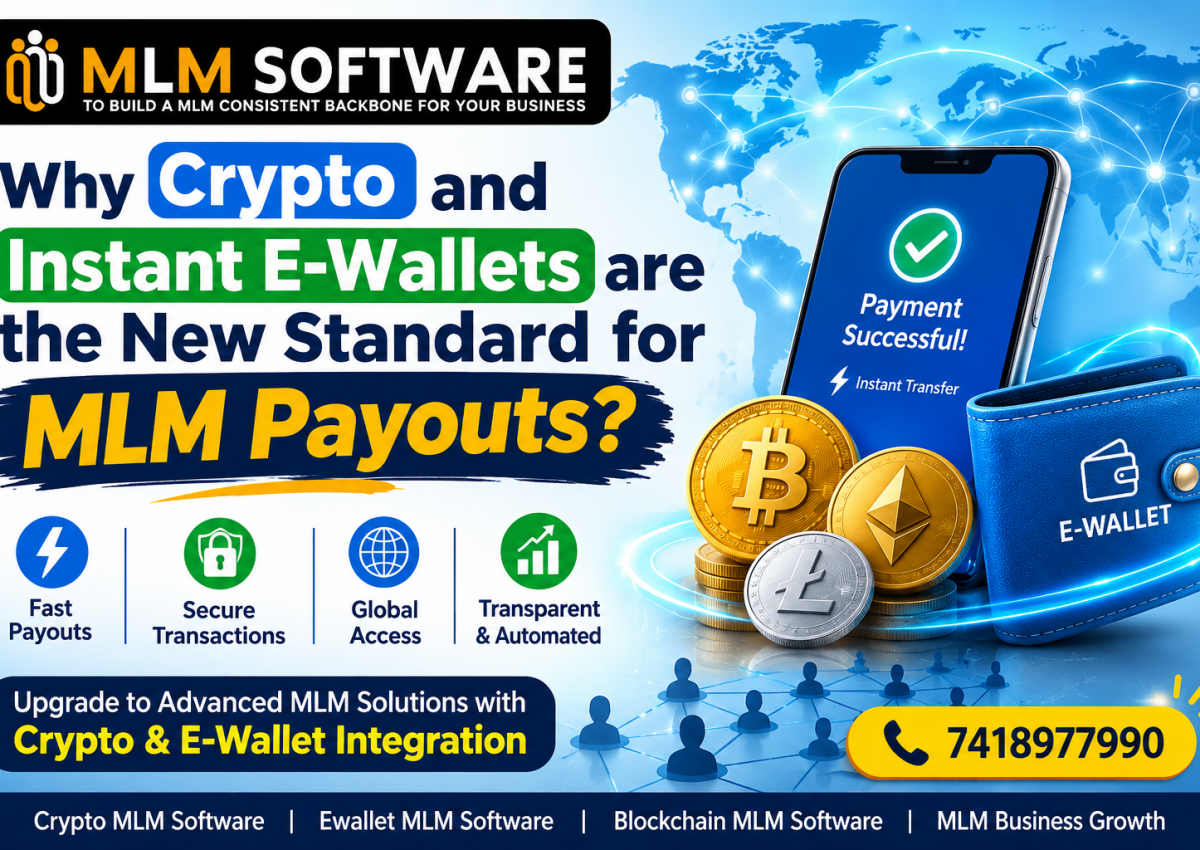
The network marketing industry is evolving rapidly as businesses adopt digital payment systems to manage commissions, distributor earnings, and financial transactions. Traditional MLM payout methods often involve manual calculations, bank processing delays, and complicated payment management. Today, cryptocurrency payments and instant e-wallet systems are changing how MLM companies handle distributor rewards.
Modern MLM businesses need payment solutions that are fast, transparent, secure, and scalable. By integrating cryptocurrency wallets, automated commission processing, and real-time transaction tracking, companies can create a smoother payment experience for distributors.
With advanced Crypto MLM Software in Palakkad, businesses can explore automated crypto payout management, while an integrated e-wallet system helps distributors access their earnings and monitor transactions more conveniently.
1. The Changing Payment Requirements of MLM Businesses
Traditional MLM compensation systems depend on different commission structures, including Binary, Unilevel, Matrix, Generation, and Hybrid plans. As distributor networks grow, calculating commissions and processing payments manually can become increasingly difficult.
Common challenges include:
- Delays in commission payments
- Manual payout calculations
- Complex distributor account management
- Limited payment options
- Transaction tracking difficulties
- Reconciliation errors
- High administrative workloads
Digital payment technology helps address these challenges by connecting commission calculations with automated payout workflows.
For companies operating across different regions, flexible payment options can also make distributor management more convenient.
2. Why Cryptocurrency Is Becoming Relevant to MLM Payouts
Cryptocurrency provides another payment option for businesses that operate within digital and blockchain-based ecosystems. Depending on the supported blockchain network and applicable regulations, companies can use digital assets to distribute eligible commissions.
Some potential advantages include:
Digital transactions: Cryptocurrency transfers can be processed through supported blockchain networks without relying exclusively on conventional payment channels.
Transaction visibility: Public blockchain transactions can be independently verified using transaction IDs and blockchain explorers.
Global accessibility: Supported cryptocurrencies may provide an additional payment option for distributors in different countries, subject to local laws and exchange availability.
Programmable payment workflows: Smart contracts can support predefined transaction rules when properly designed, tested, and audited.
Flexible payment options: Businesses can configure supported digital asset payout methods based on their operational and compliance requirements.
However, cryptocurrency payments also involve price volatility, network fees, custody risks, regulatory obligations, and transaction irreversibility. Businesses should evaluate these factors before implementing crypto payouts.
3. How Instant E-Wallets Improve Distributor Experience
An e-wallet is a digital account that allows users to view and manage their available balance and supported transactions.
In MLM businesses, e-wallets can provide distributors with a centralized place to monitor commissions, bonuses, adjustments, and withdrawal requests.
An advanced Ewallet MLM Software in Palakkad can include features such as:
- Real-time commission balance updates
- Automated bonus crediting
- Withdrawal request management
- Transaction history
- Wallet-to-wallet transfers, where permitted
- Admin approval workflows
- Payment status notifications
- Detailed financial reports
These features help distributors understand their earnings without repeatedly contacting administrators.
For MLM companies, centralized wallet management can reduce manual work and improve financial recordkeeping.
4. How Crypto and E-Wallet Integration Works in MLM Software
Combining crypto payment options with an internal e-wallet creates a connected payout workflow.
A typical process includes:
Step 1: Distributor registration
The distributor registers with the MLM platform and receives an account with access to the relevant dashboard and wallet features.
Step 2: Sales and commission calculation
The MLM system records eligible business activity and calculates commissions according to the configured compensation plan.
Step 3: Commission crediting
Approved commissions are credited to the distributor’s internal e-wallet balance.
Step 4: Withdrawal request
The distributor submits a withdrawal request through an available payment method, such as an approved bank transfer or supported cryptocurrency option.
Step 5: Verification and approval
The system performs applicable account checks, withdrawal validations, and administrative approvals.
Step 6: Payment processing
The payment is processed through the configured payment gateway, exchange, custodian, or blockchain integration.
Step 7: Transaction confirmation
The distributor can view the payment status, transaction reference, and relevant payment details.
This workflow helps connect commission management with payment processing while maintaining an auditable transaction history.
5. The Role of Blockchain in Modern MLM Payment Systems
Blockchain technology provides a distributed ledger that records transactions according to the rules of the selected network.
For MLM platforms, blockchain integration can support selected financial operations, including digital asset transfers, transaction verification, and smart contract-based payment workflows.
A well-designed Blockchain MLM Software in Palakkad solution may include:
- Blockchain wallet integration
- Smart contract functionality
- Cryptocurrency payout management
- Transaction verification
- Blockchain explorer references
- Digital asset payment records
- Role-based administrative controls
- Secure API integrations
Smart contracts can automate predefined payment rules, but they do not automatically guarantee correct commission calculations or legal compliance. Compensation logic must be properly tested, audited, and aligned with applicable business and financial regulations.
6. Traditional MLM Payouts vs. Crypto and E-Wallet Payouts
| Feature | Traditional payout methods | Crypto and e-wallet systems |
| Commission tracking | May involve separate records | Can be integrated with wallet dashboards |
| Payment options | Usually bank or cheque-based | Can include supported digital assets |
| Transaction visibility | Depends on payment provider | Wallet history and blockchain references |
| Processing | Subject to banking schedules | Depends on network and payment provider |
| Automation | May require manual coordination | Can support automated workflows |
| International payments | Depends on banking arrangements | May offer additional cross-border options |
| Price stability | Depends on the currency | Crypto assets may be volatile |
The appropriate payment model depends on distributor requirements, business location, transaction costs, compliance obligations, and available infrastructure.
7. Essential Security Features for Crypto MLM Software
Security is particularly important when software handles commissions, wallet balances, and cryptocurrency transactions.
Businesses should consider implementing:
- Multi-factor authentication
- Encrypted communication
- Secure wallet integrations
- Role-based access control
- Withdrawal limits and approval rules
- Suspicious transaction monitoring
- API authentication and access controls
- Detailed audit logs
- Secure key management
- Regular security testing
Companies should also use reputable payment providers and conduct independent smart contract audits when applicable.
Security measures should be designed to protect both distributor accounts and company financial records.
8. Choosing the Right Crypto MLM Software in Kerala
Selecting suitable MLM software requires evaluating more than the number of payment features. Businesses should consider the software’s ability to support their compensation structure, distributor network, financial workflows, and future growth.
When evaluating Crypto MLM Software in Kerala, consider these important factors:
- Flexible MLM plans: Support for Binary, Matrix, Unilevel, and other required compensation structures.
- Wallet integration: Internal e-wallet management with clear transaction records.
- Crypto compatibility: Support for the specific digital assets and blockchain networks required by the business.
- Automated commissions: Accurate calculation and crediting based on configured business rules.
- Security: Strong authentication, access controls, and secure payment integrations.
- Reporting: Financial reports, payout history, and distributor transaction statements.
- Scalability: Infrastructure that can accommodate increasing distributors and transactions.
- Compliance support: Configurable controls that support applicable legal and regulatory requirements.
A software provider should also clearly explain its security architecture, supported integrations, maintenance process, and technical support arrangements.
9. The Future of MLM Payout Management
Digital payments are creating new possibilities for network marketing companies. Internal e-wallets, payment automation, blockchain verification, and cryptocurrency integrations can help businesses modernize their financial operations.
Future MLM platforms may increasingly combine traditional payment gateways with digital asset infrastructure, allowing companies to configure payment methods based on distributor preferences and regional requirements.
However, adopting cryptocurrency should be a business decision based on genuine operational needs, legal requirements, and risk assessments rather than simply following a technology trend.
A transparent payout system, accurate commission management, and reliable customer support remain essential to building distributor confidence.
Frequently Asked Questions (FAQs)
-
What is crypto MLM software?
Crypto MLM software is a network marketing management platform that supports cryptocurrency-related features, such as digital wallet integration, crypto payout processing, transaction tracking, and automated commission management.
-
How do e-wallets help MLM distributors?
E-wallets allow distributors to view their available balance, monitor commissions, check transaction history, and submit withdrawal requests through a centralized digital account.
-
Is cryptocurrency suitable for MLM payouts?
Cryptocurrency may be suitable for certain businesses where it is legally permitted and operationally appropriate. Companies must consider volatility, transaction fees, security, tax obligations, and applicable financial regulations.
-
What is Blockchain MLM software?
Blockchain MLM software combines network marketing management features with selected blockchain capabilities, such as digital asset transactions, wallet integrations, and smart contract functionality.
-
Can MLM software support both bank transfers and crypto payments?
Yes. Depending on the software architecture and payment provider integrations, an MLM platform can support multiple payout methods, including eligible bank transfers and supported cryptocurrency payments.
-
Why should businesses invest in e-wallet MLM software?
E-wallet MLM software can centralize distributor balances, automate commission crediting, organize withdrawal requests, and provide better transaction visibility.
-
What should businesses check before choosing crypto MLM software?
Businesses should evaluate compensation plan compatibility, wallet security, supported networks, payout automation, reporting, scalability, technical support, and regulatory requirements.
Conclusion
Crypto payments and instant e-wallets are introducing new possibilities for MLM payout management. By combining automated commissions, digital wallet functionality, secure payment integrations, and blockchain-based transaction verification, businesses can create more organized and transparent financial workflows.
Companies exploring Crypto MLM Software in Palakkad, Crypto MLM Software in Kerala, or Ewallet MLM Software in Palakkad should focus on choosing a secure, scalable, and compliance-conscious solution that meets their actual business requirements.
The future of MLM payment management will depend not only on faster transactions but also on transparency, security, accuracy, and distributor trust.
