


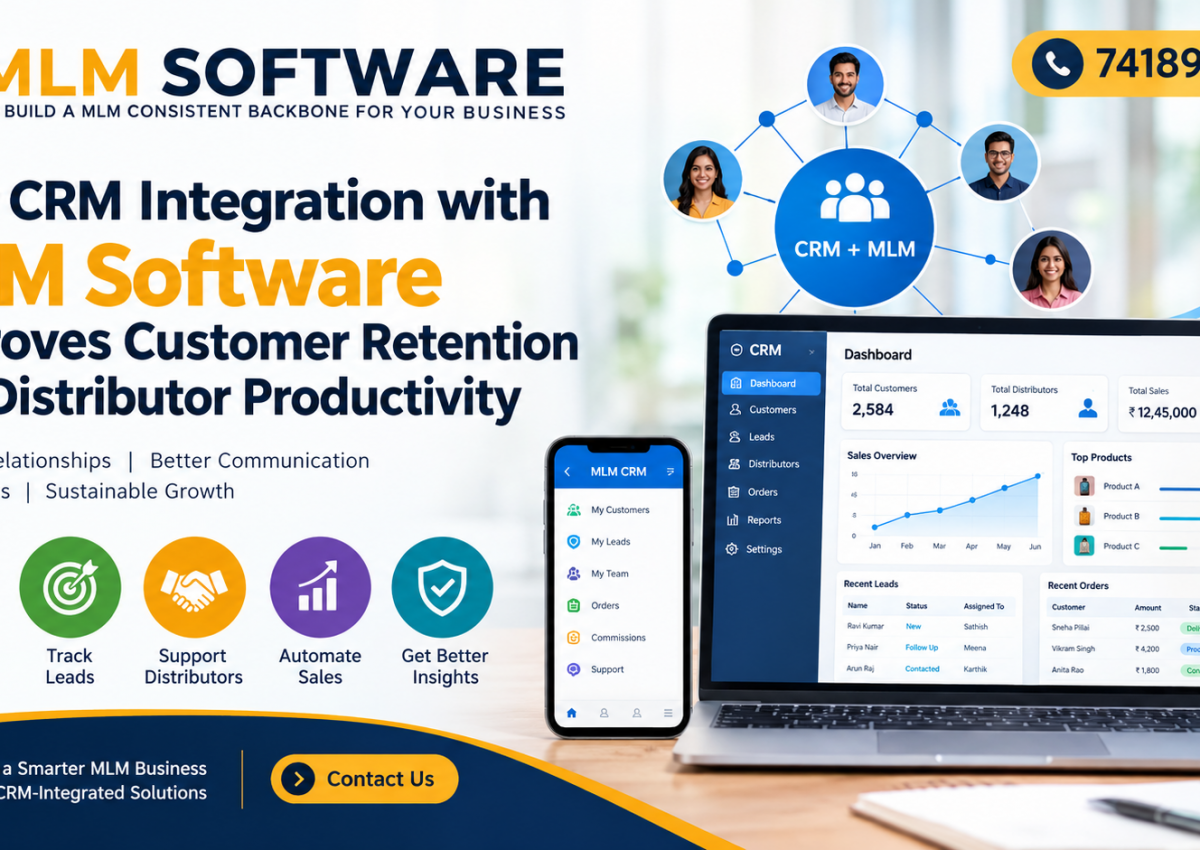
Customer relationship management is an important part of running a successful multi-level marketing (MLM) business. Companies must manage customer enquiries, distributor activities, sales, orders, follow-ups, and support requests while maintaining accurate business records.
When these activities are handled through separate applications or spreadsheets, businesses may face missed follow-ups, duplicated customer records, inconsistent communication, and limited visibility into sales performance.
CRM-integrated MLM software combines customer relationship management with network marketing operations in one platform. It helps businesses organize customer information, track leads, monitor sales activities, support distributors, and analyze business performance.
For companies looking for MLM Software in Coimbatore or MLM Software in Tamilnadu, CRM integration can be an important consideration when selecting a network marketing platform. Businesses that need customized workflows can also evaluate an experienced MLM Software Development Company to determine which features suit their compensation plans, customer management processes, and operational requirements.
What Is CRM Integration with MLM Software?
CRM integration with MLM software is the process of connecting customer relationship management functionality with an MLM platform. The integration allows businesses to manage customer records, sales enquiries, distributor profiles, orders, communication histories, and relevant reports through connected systems.
A CRM-integrated MLM platform may include:
- Lead and prospect management
- Customer contact records
- Distributor registration and profiles
- Sales and order tracking
- Customer follow-up reminders
- Communication history
- Marketing campaign management
- Customer support tools
- Commission information
- Sales reports and analytics
- Automated notifications
- Role-based dashboards
The available features depend on the software architecture, integrations, and business requirements.
Example: If a prospective customer enquires about a product, a distributor can record the enquiry, schedule a follow-up, and update the lead status. Once an order is placed, the relevant sales information can be linked to the customer record, subject to the platform’s integration capabilities.
This connected workflow helps reduce manual administration and makes customer interactions easier to track.
1. How Does CRM Integration Improve Customer Retention?
CRM integration can improve customer retention by helping businesses maintain accurate customer records and provide more consistent service.
The platform can record purchase history, product preferences, previous enquiries, support requests, and customer feedback. Authorized users can refer to this information when assisting customers or planning relevant follow-ups.
For example, a company selling products through distributors may use purchase history to identify customers who regularly reorder certain products. The system can support timely reorder reminders or relevant product information, provided the communications follow customer preferences and consent requirements.
Customer retention strategies can include:
- Personalized customer support
- Relevant product updates
- Purchase follow-up reminders
- Customer feedback collection
- Repeat-purchase analysis
- Timely resolution of service issues
CRM software does not automatically guarantee higher retention. Its effectiveness depends on product quality, customer service, appropriate communication, and how consistently the business uses the information.
2. How Can CRM-Integrated MLM Software Improve Distributor Productivity?
Distributors often manage multiple responsibilities, including contacting prospects, answering customer questions, processing orders, and supporting their teams.
CRM-integrated MLM software can bring relevant customer and business information into a centralized dashboard. This reduces the need to switch between disconnected tools.
Depending on the platform, distributors may access:
- Customer and prospect lists
- Lead status and follow-up reminders
- Product information
- Customer order history
- Sales summaries
- Team activity reports
- Commission information
- Training materials
- Support resources
For example, a distributor preparing for a customer meeting can review previous interactions and product enquiries before contacting the customer.
Mobile-compatible dashboards can also help distributors access relevant information while travelling or attending business meetings.
The objective is to simplify routine work so distributors can spend more time on customer service, product education, and legitimate sales activities.
3. How Does CRM Integration Support Lead Management?
Lead management helps businesses organize potential customers from the initial enquiry through subsequent communication and, where appropriate, a purchase.
Without a centralized system, lead details may be scattered across spreadsheets, email accounts, messaging applications, or individual distributor records.
A CRM-integrated platform can help businesses:
- Record prospect information.
- Assign leads to the appropriate distributor or team.
- Track enquiry status.
- Schedule follow-up activities.
- Record communication history.
- Review conversion trends.
Administrators can use these records to identify bottlenecks in the sales process and determine whether distributors need additional training or better product information.
Lead assignment rules should be transparent and consistent with the company’s operating policies. Access to personal information should be restricted to authorized users.
4. Which Business Processes Can MLM CRM Automation Improve?
CRM automation can reduce repetitive administrative work by triggering predefined actions when specific events occur.
Examples include:
- Creating follow-up tasks after a new enquiry
- Sending order confirmations
- Notifying distributors about assigned leads
- Reminding customers about relevant product information
- Routing support requests to the appropriate team
- Generating scheduled sales reports
- Updating lead statuses based on defined workflows
For example, when a customer submits an enquiry through a website, the system may create a lead record and notify the responsible sales representative.
Automation should be configured and tested carefully. Incorrect triggers, duplicate notifications, and outdated customer records can create a poor user experience if they are not monitored.
Commission calculations should also follow the configured compensation plan, eligibility rules, and verified transaction records.
5. How Can CRM and MLM Analytics Support Business Decisions?
Connecting CRM records with MLM sales and distributor data can give administrators a more complete view of business activity.
Depending on the available data, reporting tools may help measure:
- Lead conversion rates
- Customer repeat-purchase activity
- Product sales performance
- Order volumes
- Customer support response times
- Distributor sales activity
- Campaign performance
- Customer enquiry trends
For example, if lead conversion decreases over a particular period, administrators can investigate whether the change relates to lead quality, product availability, follow-up delays, or other factors.
These reports support evidence-based decision-making, but they should not be interpreted without considering data quality, seasonal changes, and other business conditions.
6. Can AI Improve CRM-Integrated MLM Software?
Yes. Artificial Intelligence can support CRM and MLM operations by identifying patterns, organizing information, and assisting users with selected tasks.
Potential applications include:
- AI-assisted customer support
- Lead prioritization
- Sales trend analysis
- Customer enquiry classification
- Product recommendations
- Distributor performance insights
- Business forecasting
For example, an AI-assisted analytics feature could identify customer groups with declining repeat-purchase activity. Managers could investigate the reasons and develop suitable service improvements.
AI recommendations should be treated as decision-support tools rather than guaranteed predictions. Businesses should consider privacy, data quality, transparency, and human review when implementing AI features.
7. What Features Should Businesses Look for in MLM CRM Software?
Businesses evaluating MLM CRM software should compare features against their operational requirements rather than relying solely on the number of available functions.
| Feature | Business purpose |
| Customer database | Organizes customer records and interaction history |
| Lead management | Tracks enquiries and follow-up activities |
| Distributor management | Maintains distributor profiles and team information |
| Order integration | Connects customer records with sales transactions |
| Commission management | Calculates eligible commissions based on configured rules |
| Mobile access | Supports distributors using smartphones and tablets |
| Reporting and analytics | Helps managers review business performance |
| API integration | Connects compatible external business systems |
| Security controls | Protects customer, distributor, and transaction data |
| Role-based access | Limits information access according to responsibilities |
Companies should also consider usability, scalability, data migration, maintenance, implementation costs, and technical support.
8. Choosing MLM Software in Coimbatore and Tamil Nadu
Businesses searching for MLM Software in Coimbatore should assess how well a platform supports their products, distributor network, compensation structure, and customer management requirements.
Companies operating across Tamil Nadu may also need multilingual interfaces, mobile access, centralized reporting, and integration with their existing business applications. These requirements should be confirmed during software evaluation rather than assumed to be included.
When comparing MLM Software in Tamilnadu, businesses should ask providers about:
- Supported compensation plans
- CRM and customer management capabilities
- Distributor genealogy management
- Sales and commission reporting
- Payment gateway integrations
- Data security and access controls
- Customization options
- API documentation
- Training and technical support
- Ongoing maintenance arrangements
An experienced MLM Software Development Company can help assess these requirements, plan integrations, and configure workflows according to the business model.
Before implementation, companies should document their business processes and define measurable goals, such as reducing missed follow-ups, improving reporting accuracy, or making customer records easier to manage.
9. What About Crypto MLM Software in Coimbatore?
Businesses exploring cryptocurrency-based network marketing may also evaluate Crypto MLM Software in Coimbatore.
Depending on the business model and technical requirements, such a platform may integrate MLM management features with cryptocurrency payment processing, wallet services, blockchain transaction records, or other digital asset infrastructure.
CRM functionality can still play an important role by organizing customer enquiries, support requests, account information, and relevant transaction references.
However, blockchain integration does not automatically make a business model secure, transparent, profitable, or legally compliant. Cryptocurrency-related operations require appropriate legal, tax, financial, cybersecurity, and regulatory reviews for the jurisdictions involved.
Wallet security, private-key management, transaction verification, and access controls should be assessed separately from standard CRM functionality.
Frequently Asked Questions
What is CRM-integrated MLM software?
CRM-integrated MLM software combines customer relationship management with network marketing functions. It can help businesses manage leads, customer records, distributors, sales activities, orders, and reports through connected workflows.
How does CRM integration help MLM distributors?
It can provide centralized customer information, lead tracking, follow-up reminders, order histories, product information, and sales reports. These features help distributors organize customer interactions and reduce manual administration.
Can MLM CRM software improve repeat purchases?
It can support repeat-purchase strategies by organizing purchase histories, customer preferences, feedback, and relevant follow-up reminders. Results depend on product quality, customer experience, and the effectiveness of the business’s retention strategy.
What should I check before choosing an MLM software development company?
Evaluate compensation-plan support, CRM functionality, customization capabilities, security, scalability, integration options, documentation, implementation processes, and ongoing technical support.
Can CRM be integrated with Crypto MLM Software in Coimbatore?
CRM functionality can be integrated into a cryptocurrency-enabled MLM platform, depending on its architecture and requirements. Businesses should also evaluate wallet security, transaction controls, data protection, and applicable regulations.
Conclusion
CRM integration can help MLM companies organize customer relationships, improve lead management, support distributors, automate routine tasks, and analyze sales performance.
For businesses considering MLM Software in Coimbatore or MLM Software in Tamilnadu, the key is to select a platform that connects customer management with distributor operations while maintaining appropriate security and reporting controls.
Working with a suitable MLM Software Development Company can help businesses identify essential features, integrate existing systems, and develop workflows that match their requirements.
Whether a company needs conventional network marketing software or is evaluating Crypto MLM Software in Coimbatore, technology selection should be guided by usability, security, operational needs, and applicable legal requirements.
The long-term value of CRM-integrated MLM software comes from using accurate information responsibly to deliver better customer service, support distributors, and manage business operations more effectively.
