


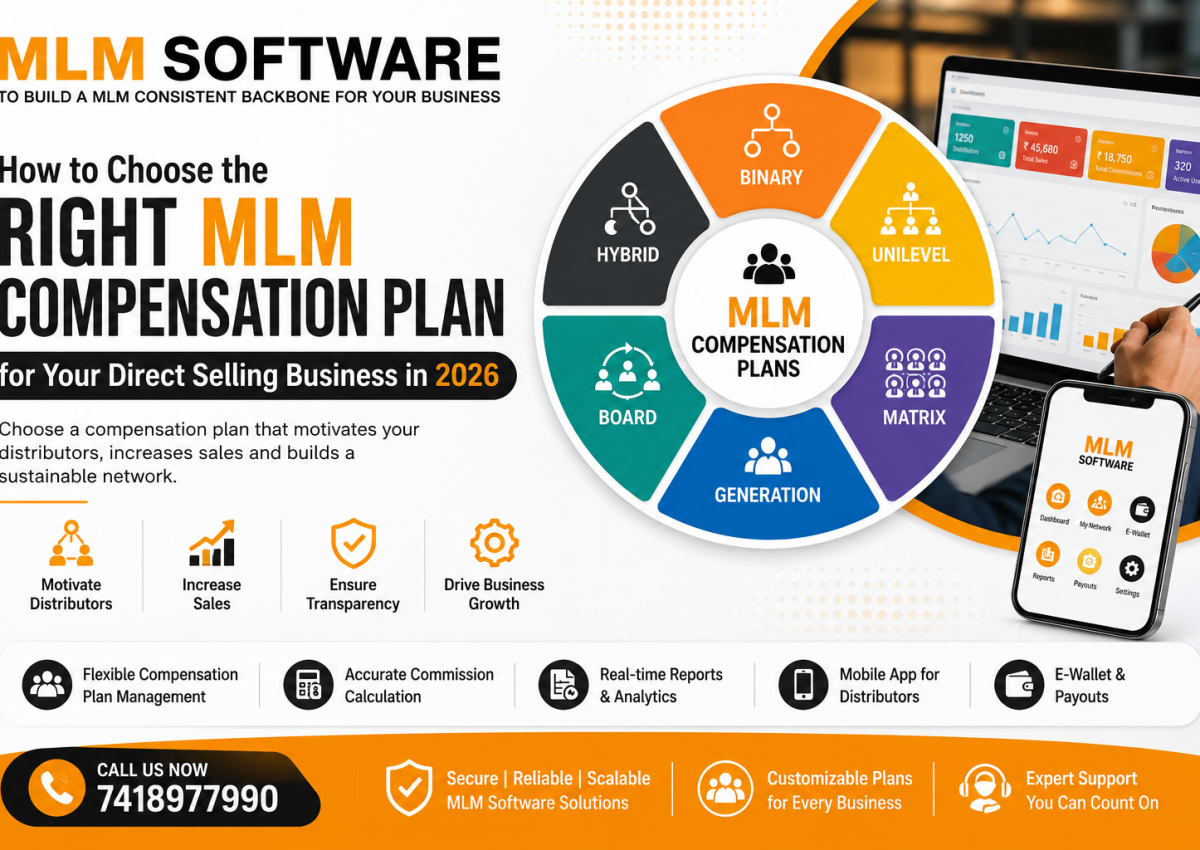
Choosing the right MLM compensation plan is one of the most important decisions for a direct selling company in 2026. Your compensation plan determines how distributors are rewarded, how sales volume moves through the organization, how leaders are incentivized, and how much commission liability the company carries.
There is no universally “best” MLM compensation plan. Binary, Unilevel, Matrix, Generation, Board, Stair-Step, and Hybrid plans can all be suitable depending on your products, margins, customer model, distributor strategy, and growth objectives.
The right approach is to design the compensation plan around the business first and then select technology that can implement it accurately.
Quick Answer: Which MLM Compensation Plan Is Best?
The best MLM compensation plan depends on your business model.
- Unilevel: Suitable when simplicity and broad frontline recruitment are priorities.
- Binary: Suitable when you want a two-leg structure and team-volume-based incentives.
- Matrix: Suitable when you want controlled width and depth.
- Generation: Suitable when leadership and generational performance are important.
- Board: Suitable for businesses using cycle or board-based reward structures.
- Hybrid: Suitable when you need to combine multiple commission mechanisms.
The most important factors are product margins, customer demand, repeat purchases, distributor behavior, commission budget, compliance requirements, and scalability.
Your compensation plan should be understandable to distributors and financially sustainable for the company.
What Is an MLM Compensation Plan?
An MLM compensation plan is the set of rules that defines how distributors can earn commissions, bonuses, incentives, and other rewards from qualifying business activities.
Depending on the model, rewards may be connected to:
- Personal sales
- Direct referrals
- Team sales volume
- Downline performance
- Rank achievement
- Leadership performance
- Matching bonuses
- Sales targets
- Customer retention
A well-designed compensation plan should encourage legitimate product or service sales and create a clear relationship between business performance and rewards.
Your plan should also be easy to explain. If a new distributor cannot understand the basic earning mechanism without a lengthy presentation, the structure may need simplification.
Why Your Compensation Plan Matters in 2026
The direct selling environment is becoming increasingly digital. Distributors expect mobile access, real-time information, automated payouts, eCommerce integration, and transparent commission reporting.
Your compensation plan therefore needs to work together with your technology platform.
Modern MLM software can automate commission calculations for Binary, Matrix, Unilevel, Generation, Board, and Hybrid structures, reducing manual calculations and helping distributors track their performance.
A compensation plan affects:
Distributor Motivation
Distributors need to understand what activities qualify them for commissions and bonuses.
Financial Sustainability
The company must ensure that commissions and incentives remain financially viable as sales volume and distributor numbers increase.
Customer Sales
A sustainable direct selling business should have genuine products or services and focus on customer value rather than making recruitment the primary economic activity.
Distributor Retention
Clear earning rules and transparent reporting can improve confidence in the compensation system.
Business Scalability
A plan that works for 100 distributors should be capable of being modeled and managed when the organization reaches thousands of distributors.
6 Popular MLM Compensation Plans to Consider
-
Binary MLM Compensation Plan
A Binary plan generally organizes distributors into two legs, often referred to as the left and right legs. Commission rules may use qualifying sales volume from these legs to determine payouts.
Binary structures can encourage teamwork and balanced organization development. However, companies need to define rules for volume qualification, carry-forward, matching, caps, inactive distributors, refunds, and other conditions.
Choose Binary when:
- You want a two-leg structure.
- Team performance is important.
- You want volume-based incentives.
- Your software can accurately manage binary calculations.
Binary MLM software can automate genealogy, placement, volume tracking, pair calculations, and payout processing.
-
Unilevel MLM Compensation Plan
A Unilevel structure generally allows distributors to sponsor multiple frontline members, with commissions paid across a defined number of levels.
It is one of the easier structures to explain because the genealogy is relatively straightforward.
Choose Unilevel when:
- Simplicity is important.
- You want flexible frontline recruitment.
- You want to reward sales across predefined levels.
- You want an easy-to-understand distributor structure.
The Unilevel model typically has unlimited width but a company-defined depth.
-
Matrix MLM Compensation Plan
A Matrix plan uses predefined width and depth. For example, a business could design a 3×5 structure, where the first number represents width and the second represents depth.
Matrix plans can encourage team development and create structured distributor placement.
Choose Matrix when:
- You want controlled network width.
- You need a defined organizational structure.
- Team placement is part of your business strategy.
- Your software can manage matrix positions and calculations.
-
Generation MLM Plan
Generation plans are designed to reward performance across generations or leadership groups within a distributor organization.
Choose Generation when:
- Leadership development is important.
- You want to reward deeper organizational performance.
- Your business has clearly defined leadership levels.
Generation-based commission calculations can become complex as the network grows, making automated software particularly valuable.
-
Board MLM Plan
A Board plan uses boards or cycles in which distributors progress through predefined stages according to the company’s rules.
Board structures can involve automated filling, splitting, cycling, and promotion mechanisms.
Choose Board when:
- Your business model is based on cycles or boards.
- You want predefined progression rules.
- You have a technology platform capable of automating board management.
-
Hybrid MLM Plan
A Hybrid plan combines two or more compensation structures.
For example, a company could combine Binary and Unilevel components with direct referral, leadership, or rank bonuses.
Choose Hybrid when:
- Your business requires multiple incentives.
- A single compensation model doesn’t meet your objectives.
- You need a highly customized commission structure.
The disadvantage is complexity. Every additional bonus should have a clear purpose and be financially modeled before launch.
MLM Compensation Plan Comparison
| Plan | Structure | Best For | Main Consideration |
| Binary | Two legs | Team-volume strategies | Requires careful volume rules |
| Unilevel | Multiple frontline members | Simplicity | Depth must be defined |
| Matrix | Fixed width & depth | Controlled growth | Placement can be complex |
| Generation | Generational groups | Leadership incentives | More complex calculations |
| Board | Cycles/boards | Structured progression | Requires automation |
| Hybrid | Combination | Customized businesses | Can become difficult to explain |
There is no winner for every business. The correct choice is the one that matches your product economics, sales strategy, distributor behavior, and long-term business goals.
How to Choose the Right Compensation Plan
Step 1: Start With Your Product
Do not start by choosing Binary or Unilevel simply because another company uses it.
First analyze:
- Product selling price
- Gross margin
- Customer acquisition cost
- Repeat-purchase frequency
- Average order value
- Target customer
- Expected monthly sales
Your compensation budget must fit your actual business economics.
Step 2: Define What You Want to Reward
Ask what behavior you want your distributors to prioritize.
Do you want to reward:
- Retail sales?
- Customer acquisition?
- Direct referrals?
- Team sales?
- Leadership?
- Repeat purchases?
- Rank advancement?
Your compensation plan should reward the behavior that contributes to sustainable business growth.
Step 3: Calculate Commission Liability
Before launching, create financial simulations.
For example, test the plan against:
- 100 active distributors
- 1,000 active distributors
- 10,000 active distributors
- Low sales volume
- Average sales volume
- High sales volume
- Different customer-retention scenarios
This helps identify whether commission payouts remain sustainable as the organization grows.
Step 4: Keep the Plan Understandable
A compensation plan can be technically sophisticated without being confusing.
Create a simple explanation covering:
- How a distributor joins.
- How personal sales qualify.
- How team sales are calculated.
- How commissions are earned.
- How bonuses are triggered.
- How ranks are achieved.
- When payouts occur.
Your distributor dashboard should present these rules in an easy-to-understand format.
Step 5: Plan for Returns and Cancellations
Your software and compensation policy should define what happens when:
- An order is cancelled.
- A product is returned.
- A payment fails.
- A distributor becomes inactive.
- A commission was calculated incorrectly.
- A customer receives a refund.
These rules should be established before the software is deployed.
Step 6: Consider Future Expansion
If you plan to expand into different states or countries, consider:
- Multiple currencies
- Multiple languages
- Payment gateways
- Tax and invoice requirements
- Local compliance
- International distributor management
- Multi-country reporting
Choosing a scalable platform early can reduce the need for major redevelopment later.
Example: Which Plan Should a New Direct Selling Company Choose?
Consider a company selling consumer products with repeat monthly purchases.
If its primary goal is simple distributor management and level-based sales incentives, a Unilevel structure may be appropriate.
If its objective is two-leg team development and volume-based incentives, Binary may be considered.
If it wants a fixed network width and depth, Matrix may be suitable.
If it wants to combine several incentives, such as direct sales, team volume, and leadership rewards, a Hybrid model could be considered.
The important point is that the company should model each option financially before choosing one.
How MLM Software Supports Your Compensation Plan
Once the compensation plan is finalized, the next challenge is managing it accurately.
Modern MLM software can automate:
- Distributor registration
- Sponsor management
- Genealogy trees
- Placement management
- Sales tracking
- Commission calculations
- Bonus calculations
- Rank management
- eWallet management
- Payout processing
- Reports and analytics
- Customer orders
- Inventory management
A modern platform can also provide distributors with dashboards showing sales, team performance, commissions, ranks, and other business information.
This is particularly important because manual commission calculations become increasingly difficult as distributor networks grow.
Choosing MLM Software in Salem
Businesses searching for MLM software in Salem should evaluate more than the number of features listed by a software provider.
The most important question is:
Can the software accurately implement and manage my compensation plan?
Before selecting a platform, check whether it supports:
- Binary compensation
- Unilevel compensation
- Matrix compensation
- Generation plans
- Board plans
- Hybrid plans
- Custom bonuses
- Rank-based incentives
- Automated commission calculations
- Distributor genealogy
- eWallets
- Payment integration
- Mobile dashboards
- Reports and analytics
A software platform should be flexible enough to accommodate your business rules without forcing you to redesign the compensation plan around the software.
The company already provides multiple compensation-plan solutions, including Binary, Matrix, Unilevel, Board, Generation, and customized MLM software.
Do You Need Crypto MLM Software?
Crypto MLM software should be considered separately from the compensation plan itself.
The compensation plan defines how distributors are rewarded.
Crypto technology defines how specific cryptocurrency or blockchain-related functions are implemented.
Depending on the legitimate requirements of a business, crypto-related software may involve:
- Cryptocurrency payment integration
- Digital wallet functionality
- Blockchain transaction records
- Token-related functionality
- Smart-contract integration where appropriate
- Transaction monitoring and reporting
However, adding cryptocurrency does not automatically make a compensation plan better.
The correct order is:
Business Model → Product/Service → Customer Value → Compensation Plan → Compliance → Technology
Crypto or blockchain functionality should be added only when it provides a genuine business purpose and can be operated in accordance with applicable laws and regulations.
Why Direct Selling Software Matters in 2026
A modern direct selling software platform should connect sales, distributors, commissions, customers, and reporting rather than treating them as isolated systems.
Important capabilities include:
- Distributor management
- Automated commissions
- Customer management
- Product management
- eCommerce integration
- Payment gateway integration
- eWallet
- Mobile applications
- Real-time reports
- Rank management
- Notifications
- Multi-language support
- Multi-currency support
Automation improves operational efficiency and gives distributors faster access to business information.
MLM Compensation Plan Checklist
Before launching your plan, ask:
- Is the product genuinely valuable to customers?
- Is the commission budget financially sustainable?
- Are commission rules easy to explain?
- Are sales and customer activity clearly defined?
- Are refunds and cancellations addressed?
- Are rank qualifications transparent?
- Are payout rules clearly documented?
- Can the plan scale?
- Can the software automate every commission calculation?
- Can distributors see their earnings transparently?
- Does the business comply with applicable regulations?
- Can the technology support future expansion?
If several of these questions cannot be answered clearly, the compensation plan may need further development before launch.
Frequently Asked Questions
Which MLM compensation plan is best in 2026?
There is no universally best MLM compensation plan. The appropriate model depends on product margins, customer demand, distributor strategy, sales objectives, commission budget, and scalability.
Is Binary better than Unilevel?
Neither is automatically better. Binary emphasizes a two-leg structure and team-volume mechanics, while Unilevel generally offers a simpler structure with flexible frontline recruitment. The best choice depends on your business model.
Can MLM software support customized compensation plans?
Yes. Custom MLM software can be developed or configured to support business-specific commission rules, bonuses, ranks, qualifications, and payout mechanisms.
What should I look for in MLM software in Salem?
Look for customizable compensation-plan support, automated commissions, genealogy management, eWallet functionality, payment integration, mobile access, reporting, security, scalability, and technical support.
Is crypto MLM software suitable for every direct selling company?
No. Crypto functionality is not necessary for every business. It should only be considered when cryptocurrency or blockchain technology has a legitimate business purpose and can be implemented in compliance with applicable requirements.
Why is direct selling software important?
Direct selling software automates distributor management, sales tracking, genealogy, commissions, payouts, reporting, and other operational processes, helping companies manage growing networks more efficiently.
Conclusion
Choosing the right MLM compensation plan in 2026 requires more than selecting a popular model. Binary, Unilevel, Matrix, Generation, Board, and Hybrid plans each have different structures, strengths, and implementation requirements.
Start with your product, customer, margins, sales strategy, and business objectives. Then design a compensation structure that rewards sustainable business activity while remaining easy for distributors to understand.
Technology should come next.
Whether you are evaluating MLM software in Salem, exploring crypto MLM software for a specific blockchain-related requirement, or looking for comprehensive direct selling software, make sure the platform can accurately implement your compensation rules and scale with your organization.
The strongest approach is simple:
Build a customer-focused business model → design a financially sustainable compensation plan → validate the numbers → automate the process with reliable software → monitor and improve the system using real business data.
That combination can provide a stronger foundation for a transparent, scalable, and technology-enabled direct selling business in 2026.
